How dissecting the Anthropocene can help improve the Loss and Damages fund
- Mar 23, 2024
- 3 min read
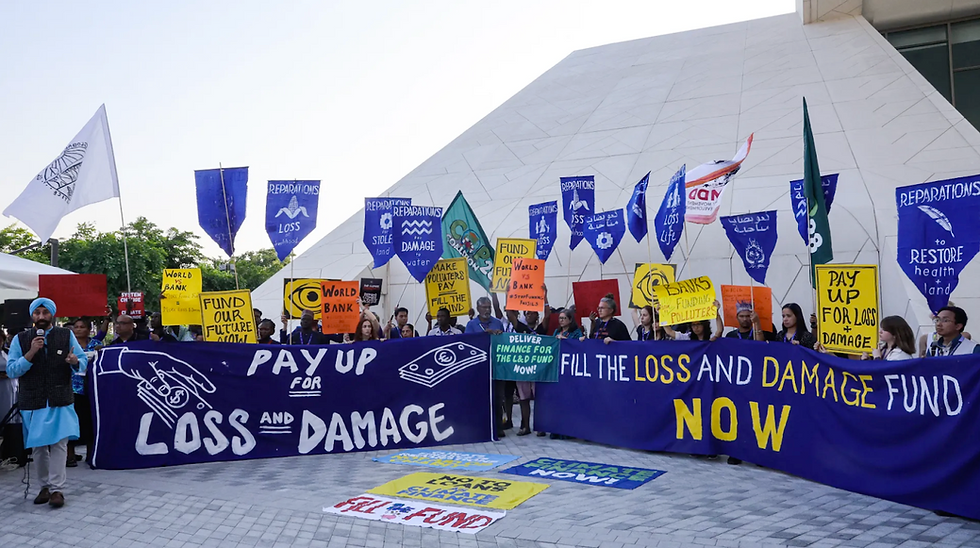
COP 28 was held in December last year with disappointing results.
For one, the committee remained committed to phasing down fossil fuels (an infuriating compromise during COP 26) instead of a complete phase out, despite 2023 climate records coming close to breaching 1.5ºC of warming — the threshold before irreversible climate change occurs.
There had also been little advancements in the development of the Loss and Damages (L&D) fund. The fund was first proposed in 1991 to compensate small-island and developing states, all of whom contributed little to climate change but face great losses from climate-related disasters. Although countries agreed to establish the fund during the previous COP, there were little advancements of this during COP 28 (no mention of timelines, targets nor obligations).
(COPs aren’t great at getting countries to stick to their commitments. Developed countries pledged to contribute $100 billion to developing countries in climate finance, a promise that they failed to keep. Even when countries did contribute their “fair share”, they did so mostly in the form of loans.)
Countries are also divided in how the fund should work. Who should contribute, through what means and who should be allowed to govern the fund? Some countries argue that emerging economies should voluntarily contribute to the fund, while others are sceptical at whether the World Bank should be the one to host the fund — rich countries have disproportionate influence over its structure and its preference of loans over grants.

This is to say that the developments at COP28 was hardly a concrete step towards climate justice. How can dissecting the concept of the anthropocene help?
What is the Anthropocene?

The Anthropocene is the recognition that human activity has come to become the profound force that shapes the earth and its planetary systems. That is, humans are largely responsible for climate change and the disasters that come from it.
Many experts date the beginning of the anthropocene during the 1850s. This was followed by the Great Acceleration in 1950, the time in which the planet saw exponential growth in carbon emissions and other forms of pollution owed to the onset of industrialisation by many countries around the world.
What’s wrong with the Anthropocene?
However, the anthropocene as a concept is problematic. While people don’t deny that human activity has contributed to climate change, the anthropocene frames the issue as something the human race as a whole is equally responsible for, when that is not the case.

For one, the anthropocene conceals the power relations between former coloniser and colonised countries — dating the anthropocene in the 1850s overlook the mass environmental destruction that European nations brought upon the new world through conquest and genocide.
Moreover, the Great Acceleration itself had been brought upon by a small group of countries in the Global North. By measuring consumption-based emissions, the Global North is responsible for 92% for the climate breakdown since the 1880s and has emitted significantly beyond their fair share of carbon.
It is therefore unfair to implicate all humans as contributors to climate change when in reality, indigenous people or those who practise pre-capitalist lifestyles around the world have for long sought to conserve and live with nature.
Some scholars argue for the concept of the capitalocene — to recognise the expansion of capital as the prime cause of environmental degradation. With this concept, we could more accurately “point the finger” to prime contributors to climate change as those who profit through the degradation of the environment.
What’s the way forward?
In the present, the L&D fund operates on the basis of voluntary contributions from developed countries. As it stands, the fund currently has a budget of around $800 million, which more than pales in comparison to the $400 billion in climate-related damages that developing and small island states face each year.
By going beyond the anthropocene and recognising the stark degree of differentiated climate responsibility, former coloniser states should be held to significantly more pressure to contribute to the L&D fund by policymakers and citizens alike. Multinational corporations could also be held accountable and contribute to the L&D fund.
More importantly, the anthropocene debate illuminates the need to go beyond the universalising language prevalent in climate action to give power to the different ways of knowing, conserving and protecting our planet.


Comments